Long-Form vs. Short-Form Content: What Converts Better in Your Industry
Introduction
Every few months, some marketing guru declares long-form content dead. Then, right on cue, someone else drops a 3,000-word guide that ranks #1 on Google and drives half their leads for the year. So which is it?
Honestly, neither side is wrong — they’re just answering different questions. This was never really a debate about word count. It’s about intent. Someone scrolling Instagram on their lunch break wants something quick and punchy. Someone about to sign a five-figure software contract wants to read every last detail before they trust you with their money. Same person, completely different appetite for content, depending on what they’re trying to do in that moment.
And honestly, our habits as content consumers have gotten weirder and more split than ever. Some days you want the 15-second video that gets straight to the point. Other days you’re three tabs deep into a 20-minute article because you actually care about the topic. Throw AI-generated summaries into the mix — which now pull from both short and long content to answer questions instantly — and you’ve got a landscape where no single format wins across the board. It really comes down to your industry, where your reader is in their buying journey, and what they showed up wanting in the first place.
Defining the Terms (Quickly, I Promise)
Let’s get on the same page before going further.
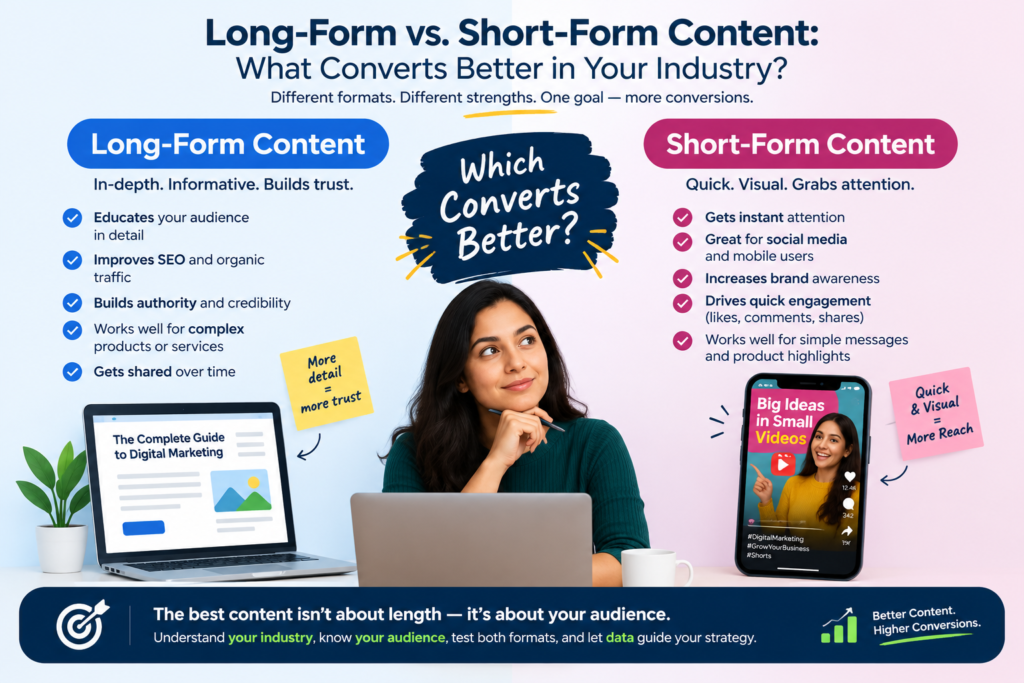
Short-form is your social posts, quick blog updates, and bite-sized video — usually under 800 words or under a minute of watch time. It’s built to deliver value fast, with zero fluff.
Long-form is your deep-dive guides, whitepapers, pillar pages, and extended video content — typically north of 1,500 words. It exists to answer not just the obvious question, but every follow-up question that comes after it.
Here’s the thing though — you don’t have to pick one. The businesses winning at content right now aren’t choosing a lane; they’re using both, and using each one where it actually earns its keep
Where Short-Form Wins
Short-form is a top-of-funnel machine. It’s how you get in front of people who’ve never heard of you and give them a reason to care in under 30 seconds.
It thrives on social and discovery platforms because those algorithms are basically built for it — fast hooks, quick payoff, minimal commitment. It’s also cheap and fast to produce, which means you can throw ten ideas at the wall this week and know by Friday which ones actually landed.
Use it for: quick tips, product spotlights, jumping on trending conversations, and retargeting people who’ve already shown interest but need a nudge.
Where Long-Form Wins
Long-form plays a completely different game — it’s how you build trust and stick around in search results for years, not days.
When you go deep on a topic, you’re not just being thorough for the sake of it. You’re signaling to readers (and to Google) that you actually know what you’re talking about. That matters a lot when someone’s making a big or complicated decision — nobody buys enterprise software or books a $10,000 service based on a 60-second reel. They want proof, comparisons, and answers to the questions they haven’t even thought to ask yet.
Use it for: comparison guides, real case studies with real numbers, comprehensive how-tos, and the kind of thought leadership that makes people trust you before they’ve even talked to your sales team.
What This Looks Like in Different Industries
B2B SaaS and high-consideration services — Long-form usually wins the deal. Buyers here are doing real research, often comparing multiple vendors, and they want depth. Short-form still earns its place for awareness and social proof, but it rarely closes the sale on its own.
E-commerce and DTC — Short-form runs the show for discovery. People are finding products through quick video and scroll-stopping posts, not blog articles. That said, long-form buying guides and well-optimized category pages still quietly do a lot of SEO heavy lifting.
Local and service businesses — Short-form builds the community feel — quick updates, before-and-afters, local shoutouts. Long-form is where you answer the questions people are actually Googling, like detailed FAQs and service breakdowns that build credibility before they ever call you.
Media and publishing — It really depends on how you make money. Ad-supported sites often chase volume with shorter pieces to rack up pageviews. Subscription-based publishers lean into depth, because that’s what justifies someone paying to read you.
Finance, healthcare, and legal (the YMYL stuff) — Long-form tends to dominate, and for good reason. These are literally “Your Money or Your Life” topics, so both readers and search engines expect — and reward — real depth, accuracy, and trustworthiness. Nobody wants a quick take on their tax strategy or a medical diagnosis.
Matching Format to Where Someone Is in the Funnel
This might be the clearest way to decide:
- Awareness stage: Short-form does the heavy lifting. Low commitment, quick discovery.
- Consideration stage: Long-form takes over. This is where guides and comparisons help people actually evaluate their options.
- Decision stage: A blend works best — quick testimonials and demo videos for reassurance, backed up by in-depth case studies for anyone who wants the full picture before they commit.
How to Stop Guessing and Actually Test This
You don’t need to take my word — or anyone else’s — for which format works better. Your own data already has opinions:
- Dig into your analytics. Look at time-on-page, scroll depth, and conversion rates broken down by content type.
- Run a real test. Cover the exact same topic in a short-form and long-form version, then see which one actually moves the needle.
- Look past pageviews. Dwell time, shares, and — most importantly — lead conversions and assisted conversions tell you a lot more about what’s really working.
Why the Real Answer Is Probably "Both"
Here’s what the smartest content teams have figured out: this isn’t an either/or decision. Short-form and long-form work best as a system, not competitors.
Short-form content drives traffic toward your long-form “pillar” pieces, and those pillar pieces reinforce your authority on a topic. Meanwhile, one solid long-form piece can be sliced and diced into a dozen short-form assets — stretching its value way past the effort it took to create.
A simple example: one in-depth guide turns into five social posts, a short video, and an email — all quietly pointing back to that same core piece of content, doing the work of ten separate ideas.
The Bottom Line
Length was never the real strategy — it’s just a tactic. The actual question is: what does your audience need right now, given your industry, where they are in their journey, and how they like to consume information?
So take a hard look at your content calendar. Does it actually match how people move through your funnel, or are you just making what’s easiest to produce? That gap — not the long-form-vs-short-form debate — is usually where the real opportunity is hiding.