Local SEO for Small Businesses in 2026: GBP Optimization, Reviews & Local Search Trends
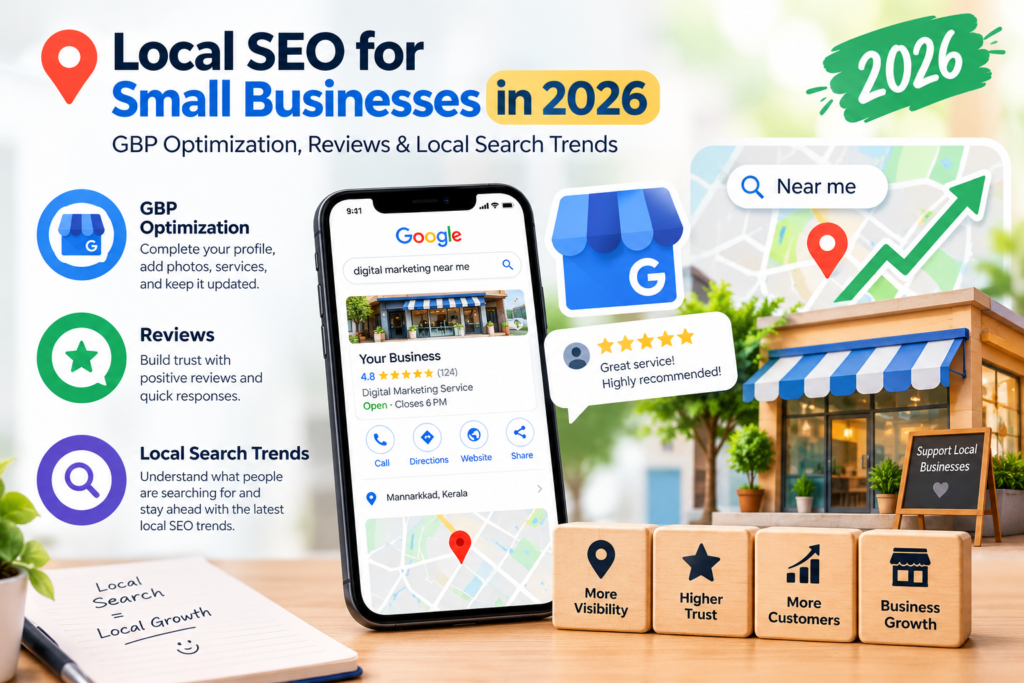
Introduction
Someone’s standing two blocks from your shop, phone out, typing “best coffee near me.” Google hands over three businesses — ratings, photos, hours, a click-to-call button — right on the screen. Miss that top three and you’re invisible in that moment.
That moment matters: about 76% of “near me” searchers show up somewhere within 24 hours, and 28% buy something. For a small business, that traffic can quietly outperform social media and paid ads combined.
2026 has changed things a bit — AI Overviews now sit above the old local 3-pack, and people type full questions instead of keywords. Still, local SEO remains one of the few battlegrounds where a small shop can beat a national chain, because these rankings reward real community trust, not ad budgets.
1. Where Local Search Stands Right Now
AI Overviews favor businesses with strong profiles, plenty of reviews, and content that actually answers local questions — so nailing the 3-pack basics gets you most of the way there. Zero-click searches mean people often grab your hours and address straight off your Google Business Profile without ever hitting your website, which makes accuracy there non-negotiable. Searches themselves have gotten chattier — “pizza near me open now with outdoor seating” — and mobile speed matters more than ever, since well over 60% of searches happen on a phone. Meanwhile, AI tools are quietly reading your profile, your site, and the tone of your reviews — the whole reason people now talk about GEO, or Generative Engine Optimization.
2. Treat Your Google Business Profile Like the Foundation It Is
Claim and verify at business.google.com, and steer clear of the usual suspension traps — P.O. boxes, keyword-stuffed names, a burst of edits right after verification.
A handful of things genuinely move the needle:
- Category — your primary category carries real weight, so match it to your core service.
- Description — 750 characters is enough for keywords, location, and one specific reason to choose you. Skip the filler.
- Attributes — accessibility, women-owned, outdoor seating — these affect filtered searches and build trust.
- Photos and video — profiles with photos pull 42% more direction requests and 35% more clicks. Add a few monthly, and don’t skip short video walkthroughs; hardly anyone’s using them yet.
- Posts — one or two a week. They expire in 7 days, but that’s fine — the point is showing you’re active.
- Products/services — list each one with pricing. This is exactly what AI Overviews like to pull from.
- Q&A — seed your own FAQs before a stranger posts something wrong.
- Messaging/booking — turn it on and answer fast, or Google may shut it off.
- Insights — glance at direction requests, photo views, and search queries every month.
3. Reviews Are Doing More Work Than You Think
Reviews are still a top-three ranking factor, and star count is the least of it. What counts: volume, recency, sentiment (AI is reading the actual words now, not just averaging stars), and steady velocity.
Put a real system behind this — automated review requests by email or text after service, QR codes at checkout, staff trained to ask when a customer’s genuinely happy. Then answer everything. A good review deserves a specific reply, not “thanks!” A bad one needs acknowledgment, an apology where it’s earned, and a quick move to fix things offline. Slip a keyword in naturally — “glad we could help with your kitchen remodel in Buckhead” — and it reads human and still does its job.
Flag fake reviews through your profile instead of trying to bury them with purchased ones. Spread across Yelp, Facebook, and whatever fits your industry (Houzz, Healthgrades, Avvo), since AI tools now draw from more than just Google — and repurpose your best reviews into testimonials, social posts, and FAQ answers.
4. The Technical Groundwork
Keep your NAP — name, address, phone — identical everywhere. Audit it with Moz Local, BrightLocal, or Whitespark. If you’ve got multiple locations, each one needs its own page with its own NAP, map, and photos, not a copy-paste job. Add schema markup (LocalBusiness, Review, FAQ, Service) so you’re eligible for rich snippets and AI Overviews — most SEO plugins do this without touching code. Keep an eye on Core Web Vitals: LCP under 2.5 seconds, INP under 200ms. Someone searching “near me” on their phone isn’t sticking around
for a slow page. And link your service pages to your location pages, with anchor text that actually says something.
5. Building Real Links & Citations
Lock in the big citations first — GBP, Apple Maps, Bing Places, Yelp, Facebook, BBB, Foursquare — then move to whatever’s industry-specific (Houzz, Healthgrades, Avvo, Angi). Clean up duplicate listings; they just confuse search engines about which version of you is real. And earn genuine local links the old-fashioned way: chamber membership, sponsoring events, partnering with nonprofits, offering local journalists something worth quoting.
6. What's Coming Down the Road
AI chat tools — ChatGPT, Perplexity, Google’s AI Mode — are increasingly answering local questions outright, and strong reviews plus well-structured content improve your odds of being the one they cite. Under-35 audiences are searching TikTok and Instagram for local spots, so geotagging your content actually matters now, and location-tagged Reels or Shorts stretch your reach further than the platform itself. Hyperlocal content — neighborhood guides, “best of” roundups — is still underused as a way to earn links. And as privacy rules tighten, your own email list and loyalty program become more valuable than ever.
7. Keep One Eye on Competitors
Once a month, check their GBPs — categories, review velocity, photo quality, how often they’re posting. Whitespark’s Citation Finder surfaces citation gaps, Semrush or Ahrefs shows content gaps, and a Google Alert on their name keeps surprises to a minimum
8. Actually Measuring This
Track local pack rankings, calls, direction requests, website clicks, and how fast reviews are rolling in. A grid-based tool like Local Falcon or BrightLocal gives a truer picture than one rank check, since rankings shift depending on where the search happens. Call tracking plus a “how did you find us” question gets you close enough on ROI — perfect attribution isn’t realistic, but the trend line tells you what you need.
9. The Actual Plan
First 30 days: Claim and verify GBP, fix any NAP mismatches, fill out every profile section, upload 10+ photos, seed FAQs, ask loyal customers for reviews, respond to every existing one, add schema, and clear up PageSpeed issues.
First 90 days: Month one is foundation — citations, call tracking, a review system. Month two is content and technical — location pages, schema, hyperlocal posts. Month three is competitive analysis and getting measurement in place.
Ongoing: Weekly posts and review replies, monthly dashboard checks and fresh photos, quarterly competitor audits and citation cleanups.
Conclusion
Local SEO in 2026 has more moving parts than it used to, but the fundamentals haven’t budged: a well-kept profile, honest reviews, solid technical bones, and an eye on where search is headed. A national chain can outspend you on ads all day — but it can’t fake community trust or manufacture the kind of reviews a real local business earns. That’s still yours to build.